
Home / Methodology
Evaluation Framework
CEGAI
Economic Impact and Spillover Evaluation Framework
A framework we are developing to track the economic spillover effects of defence and advanced-technology investment, channel by channel.
CEGAI is a framework under development.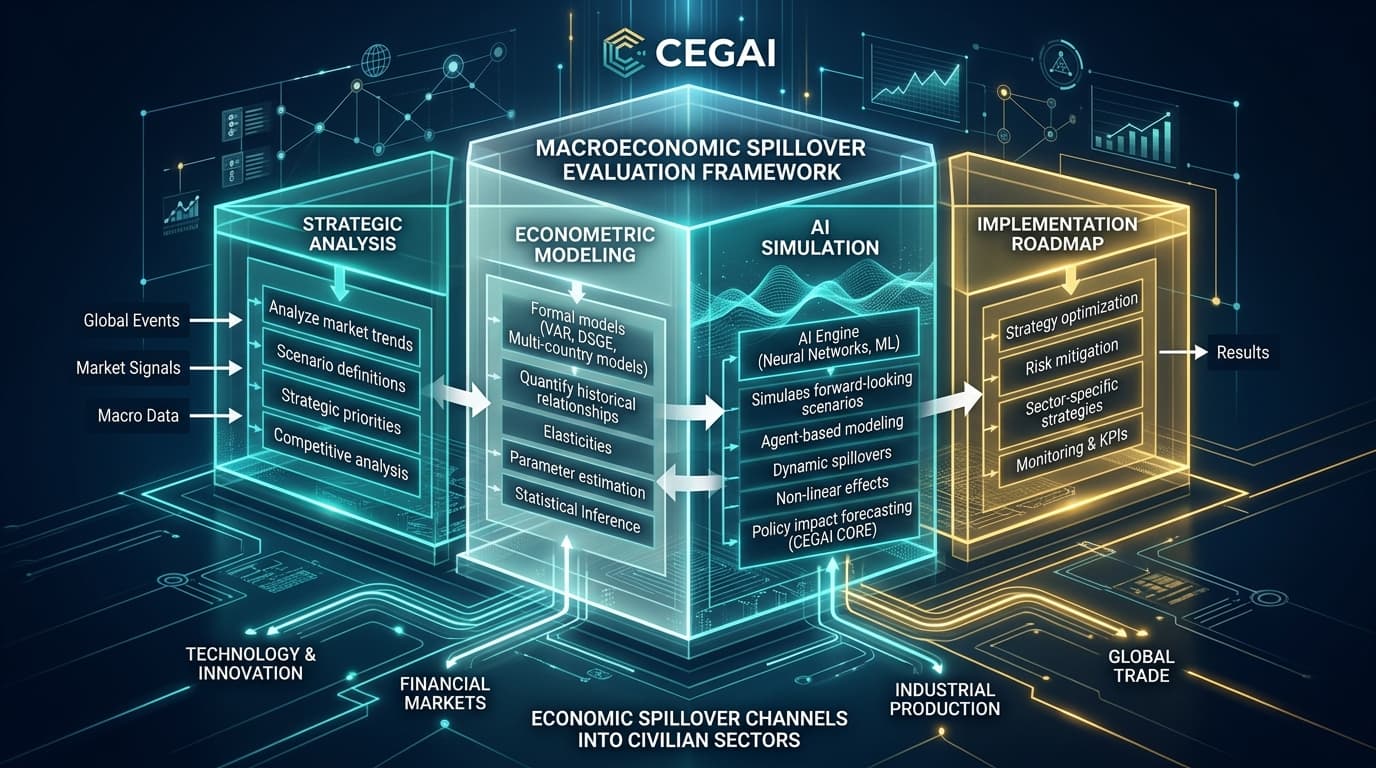
The Question
What are we not measuring?
The cost of a defence programme is known with precision. So is the number of platforms delivered. Yet the same programme's effect on supplier firms' capabilities, the quality of the engineering workforce, and the products it enables in entirely different sectors is usually left unmeasured.
These secondary effects — known in the literature as "spillovers" — are what actually matters to institutions allocating public funds, because an investment's economic legitimacy rests less on its direct output than on the capacity it leaves behind.
CEGAI aims to assess these secondary effects not through forecasting, but through defined channels and parameters verified in the literature.
Spillover Channels
Which channel does the impact travel through?
CEGAI does not reduce an investment's economic impact to a single multiplier. It tracks the impact across five distinct channels, each with its own indicator, its own data source and its own range of uncertainty.
- 01
Supply Chain
The effect on the R&D effort, innovation capacity and productivity of firms that supply the programme. This channel strengthens markedly for high-technology procurement.
Castelnovo, P., Florio, M., Forte, S., Rossi, L., Sirtori, E. (2018). The economic impact of technological procurement for large-scale research infrastructures: Evidence from the Large Hadron Collider at CERN. Research Policy, 47(9), 1853–1867.https://www.sciencedirect.com/science/article/abs/pii/S004873331830163XThis finding belongs to third-party academic literature; it is not a Çeliron study. - 02
Knowledge and Technology Transfer
The conversion of technology produced under the programme into firm-level commercial output and additional private R&D spending.
Hertzfeld, H. R. (2002). Measuring the Economic Returns from Successful NASA Life Sciences Technology Transfers. The Journal of Technology Transfer, 27(4), 311–320.doi:10.1023/A:1020207506064This finding belongs to third-party academic literature; it is not a Çeliron study. - 03
Human Capital
The effect created as qualified engineering labour accumulates in a region and, over time, moves into other sectors.
Robbiano, S. (2022). The innovative impact of public research institutes: Evidence from Italy. Research Policy, 51(10).doi:10.1016/j.respol.2022.104567This finding belongs to third-party academic literature; it is not a Çeliron study. - 04
R&D Complementarity
Public R&D spending crowding private-sector R&D in rather than substituting for it — the effect the literature calls "crowding-in".
Moretti, E., Steinwender, C., Van Reenen, J. (2025). The Intellectual Spoils of War? Defense R&D, Productivity, and International Spillovers. The Review of Economics and Statistics, 107(1), 14–27.https://direct.mit.edu/rest/article/107/1/14/114751/This finding belongs to third-party academic literature; it is not a Çeliron study. - 05
Clustering and Entrepreneurship
The persistence of the technology clusters and new ventures a programme triggers, after the programme itself has ended.
Gross, D. P., Sampat, B. N. (2023). America, Jump-Started: World War II R&D and the Takeoff of the US Innovation System. American Economic Review, 113(12), 3323–3356.doi:10.1257/aer.20221365This finding belongs to third-party academic literature; it is not a Çeliron study.
Process
How is an assessment built?
- 01
Scope and Boundary Definition
Which programme, over what time span, within what geographic boundary? What is excluded is also stated explicitly.
- 02
Channel Mapping
Which of the five spillover channels are meaningful for this programme is determined; channels judged not meaningful are excluded, with reasons given.
- 03
Indicators and Data Set
A measurable indicator and data source is defined for each active channel. Indicators for which no data can be found are flagged as gaps in the report.
- 04
Modelling and Sensitivity Analysis
Parameters drawn from the literature are applied with contextual adjustment; the result is produced not as a single figure but as a range and a set of scenarios.
- 05
Decision-Support Reporting
Findings, assumptions and uncertainties are reported together. The report is written so that a non-technical decision maker can also evaluate it.
Limits
What CEGAI is not
It is not a forecasting engine.
If input quality is poor, the output is unreliable too; the model does not close that gap.
It does not produce a single multiplier.
Impact is reported channel by channel and as a range; no single definitive figure is offered.
It does not replace the literature.
The parameters used are drawn from third-party studies and shown with their source.
It is not a finished product.
CEGAI is still a framework under development and is revised as it is applied.
Evidence Base
The verified literature the framework draws on
Every parameter CEGAI uses comes from third-party studies published in peer-reviewed journals or by institutions. We publish all of these studies together with their source citations and DOI numbers.
Literature and Evidence Base