

We measure the real economic impact of defence investment.
Çeliron is an advisory firm that assesses the direct, indirect and spillover effects of defence industry programmes through a framework grounded in academic literature.
Our Service Areas
Five areas of expertise
Çeliron's services are organised into five clusters spanning the defence industry ecosystem — from the policy level to technology centres.
 KÜME // 01
Strategy and Policy
Institutional and policy-level defence industry strategy, industrialisation roadmap design, and offset / industrial participation design.
Explore KÜME // 02
Procurement and Programme Management
RFI/RFQ processes, contract structuring, technology and production transfer, and programme management disciplines.
Explore KÜME // 03
Collaboration and Capacity Building
Strategic partnerships, indigenisation and engineering capacity, and human resource development programmes.
Explore KÜME // 04
R&D and Innovation Programmes
R&D and innovation programme design, ecosystem management, and application of the CEGAI assessment framework.
Explore KÜME // 05
Technology Centres
Advanced applied technology centres: establishment of an engineering centre of excellence, manufacturing, open innovation and Agentic AI centres.
Explore
Our Assessment Framework
CEGAI
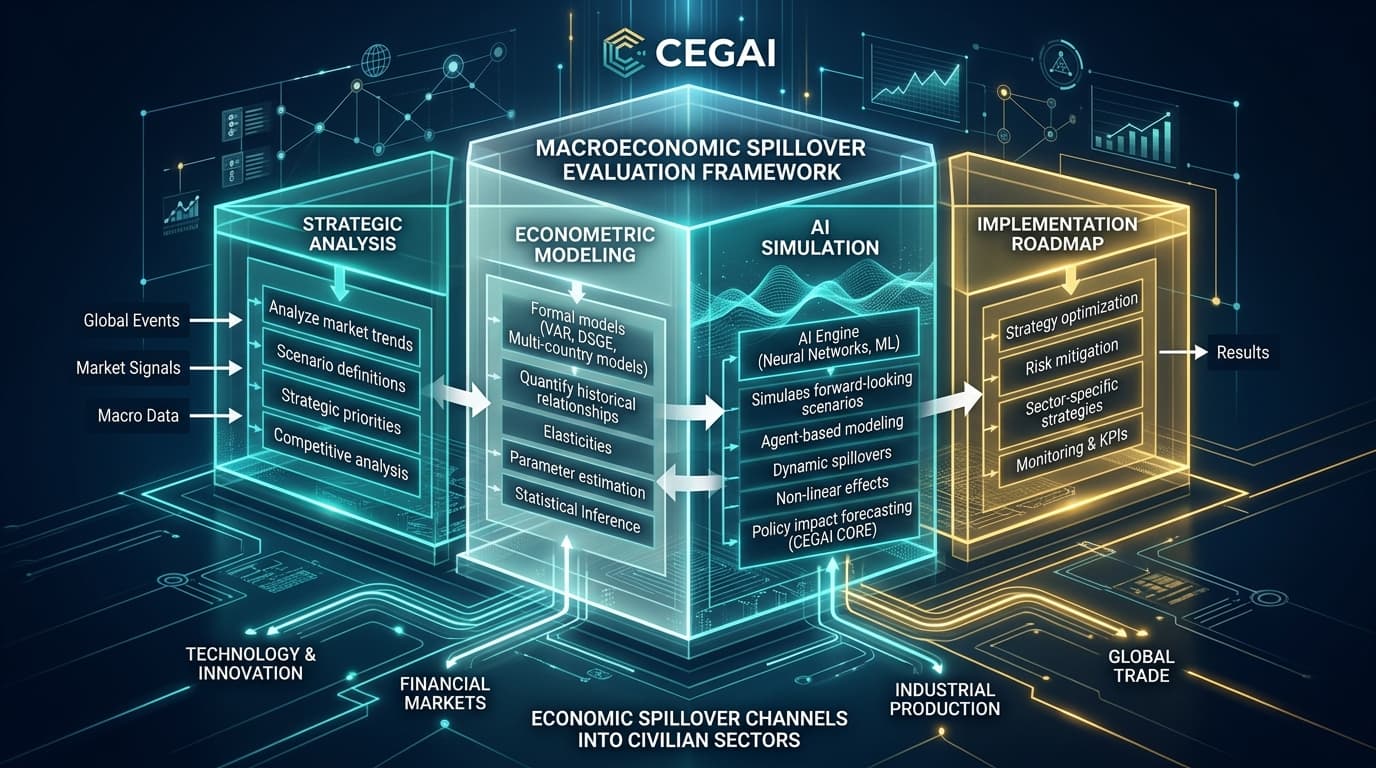
CEGAI is an assessment framework we are developing to track, channel by channel, the spillover effects of defence and advanced technology investment on the economy. It examines not the direct output of an investment, but the secondary effects that output creates through the supply chain, knowledge transfer, human capital and clustering.
- Channel-based impact mapping
- Literature-based parameter selection
- Sensitivity and uncertainty analysis
- Decision-support reporting
Compare published spillover findings
Select a published programme or study below to see its own reported figure, context and source — not a Çeliron estimate.
A comprehensive analysis of Sweden's JAS 39 Gripen programme found that the programme investment produced a social return of at least 2.6 times its value.
This value is presented as a LOWER BOUND, not a point estimate.
Our Approach
Why Çeliron
- MODÜL // 01
Evidence-based
Every quantitative finding we use is presented with a citation to peer-reviewed academic literature and its full source.
VERIFIED CAPABILITY - MODÜL // 02
Methodological transparency
Assumptions, limits and uncertainty ranges are a visible part of the report; a single precise figure is never promised.
VERIFIED CAPABILITY - MODÜL // 03
In policy language
Outputs are produced in a reporting format usable by decision makers as much as by technical teams.
VERIFIED CAPABILITY - MODÜL // 04
Global vision
The framework is being designed so that it can be adapted to different country and programme contexts.
VERIFIED CAPABILITY
Evidence Base
The literature our framework rests on
Our methodology rests on verified findings from third-party academic studies. These findings are not Çeliron's own results; they are published together with their sources and DOI numbers.
This finding belongs to third-party academic literature; it is not a Çeliron study.
A comprehensive analysis of Sweden's JAS 39 Gripen programme found that the programme investment produced a social return of at least 2.6 times its value.
Eliasson, G. (2010). "Advanced Public Procurement as Industrial Policy: The Aircraft Industry as a Technical University." Springer, Economics of Science, Technology and Innovation, vol. 34. ISBN 9781441958488. Additional source: Eliasson, G. (2017). "Visible Costs and Invisible Benefits: Military Procurement as Innovation Policy." Springer.
Becoming a CERN supplier has a positive and statistically significant effect on firms' R&D effort, innovation capacity, productivity and profitability; the effect stems predominantly from high-technology procurement.
Castelnovo, P., Florio, M., Forte, S., Rossi, L., Sirtori, E. (2018). "The economic impact of technological procurement for large-scale research infrastructures: Evidence from the Large Hadron Collider at CERN." Research Policy, 47(9), 1853–1867.
A 10% increase in publicly funded R&D produces an additional 5–6% increase in private-sector R&D; defence R&D is a complement to private R&D, not a substitute for it. A permanent one-percentage-point rise in the ratio of defence R&D to value added raises total factor productivity growth by 0.08 percentage points.
Moretti, E., Steinwender, C., Van Reenen, J. (2025). "The Intellectual Spoils of War? Defense R&D, Productivity, and International Spillovers." The Review of Economics and Statistics, 107(1), 14–27.
Want to assess the economic impact of a programme?
You can reach us directly to discuss scope and approach.
info@celiron.com.tr